AI Slop
Coding assistants feel effortless. The evidence says they make us write more code and work slower, and the dependency that builds only benefits one party.
The problem we are facing is the long-term effect of AI usage in companies. Right now it all seems nice and easy. Writing a new function is done in seconds. Making a new app takes a few hours. Getting code summaries takes no time at all. What we do not understand is what the long-term impact of using these tools actually is.
Problems of using AI
For a simple query — write a function to test if the age of a user is at least 23 — we get the following output:
MINIMUM_AGE = 23

def is_at_least_minimum_age(age):
    """Return True if age is at least MINIMUM_AGE (23).

    Raises TypeError if age is not a number, ValueError if age is negative.
    """
    if isinstance(age, bool) or not isinstance(age, (int, float)):
        raise TypeError(f"age must be a number, got {type(age).__name__}")
    if age < 0:
        raise ValueError(f"age must be non-negative, got {age}")
    return age >= MINIMUM_AGE
It is pretty easy to write a simplified, optimized solution for this problem:
def is_at_least_minimum_age(age):
    """Check if minimum age 23
    """
    return age >= 23
So here it is pretty clear that we can save a lot of lines of code by using logic instead of using AI.
More code means more tokens
Across 90 problems solved both by Microsoft Copilot and by the top-voted human solutions on LeetCode, the AI version had a higher average line count in around 60% of the pairs: 53 of the 90, against 30 where the human version was longer and seven ties.1
Now let's talk about debugging with that much extra context. As the number of lines grows, developers usually prefer using AI to debug them, and that consumes tokens. Keeping in mind that the number of tokens used is directly proportional to the cost companies incur as their AI bill, if AI continues writing long code it is actually helping AI companies charge you more.
This might seem like just a coincidence. Let's take a deeper dive into it.
Developers are slower, not faster
Developers spend more time writing code with AI than they do writing it themselves.2 When using AI, developers were expected to be faster. The numbers suggest the opposite: experienced developers were 19% slower when using AI.
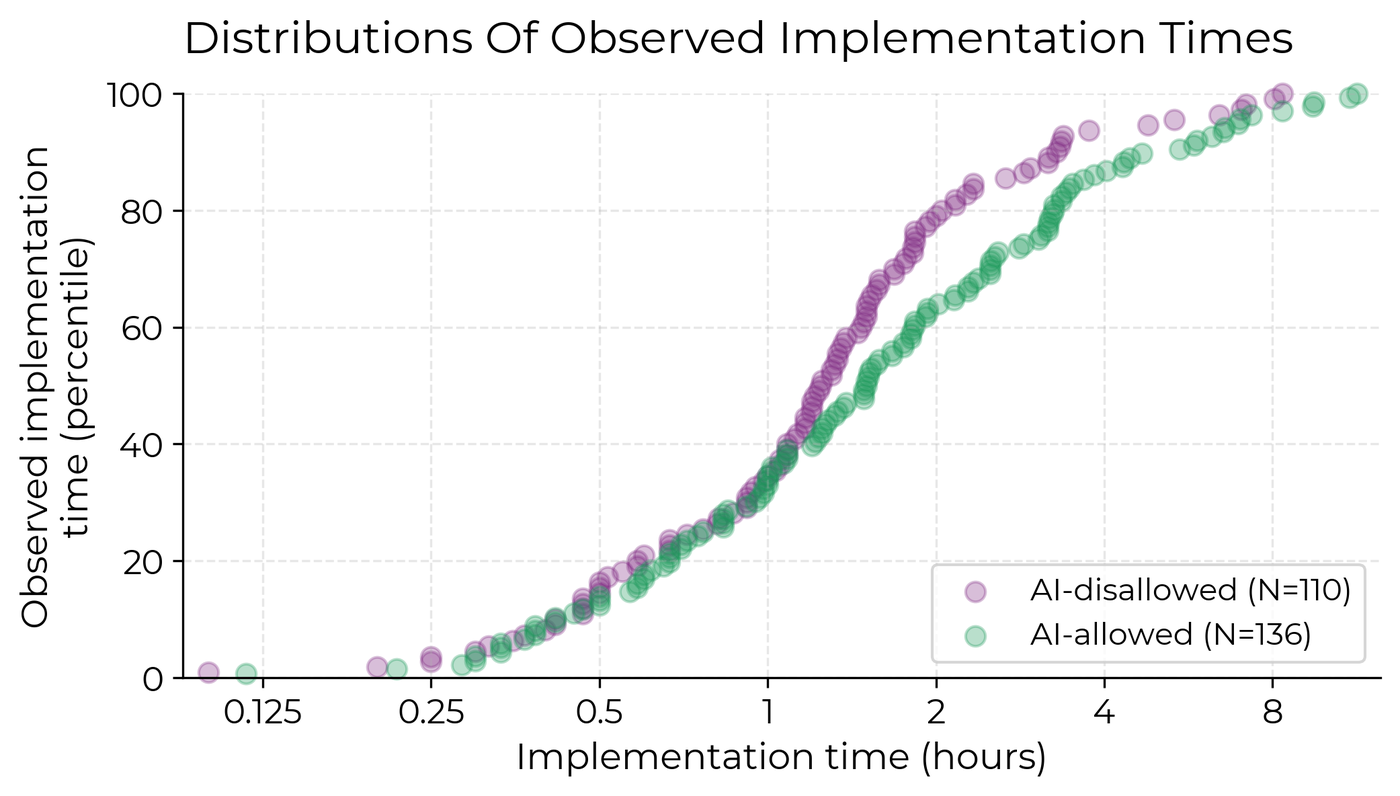
Empirical cumulative distribution functions of observed implementation times. Percentile ordering is calculated separately for each treatment group. Figure 5 from Becker et al., arXiv:2507.09089, used under CC BY 4.0.
The two groups track each other closely on tasks under an hour and separate above that, so the slowdown is concentrated in the longer tasks.
The study covered 246 tasks across 16 experienced developers, working in mature repositories they already knew well. The part worth sitting with is the gap between what the developers felt and what the clock said. Beforehand they predicted AI would make them 24% faster. Afterwards, having actually been 19% slower, they still believed it had made them 20% faster.
So why are we using it so much?
Let's take a step back and talk about logic. If developers are slower, why are we using AI so much? The answer is that it makes our job effortless. We do not think about debugging the bugs later, we do not think about how long it takes, and we do not think about how much weaker we get as developers each time we use it. Why? Because we love the illusion of seeing code written faster, even though the code is inefficient and will be a pain to review.
Who is benefiting from it
The ones benefiting from it are AI companies, and AI companies alone. How? As we get more and more dependent on our coding assistants, we lose the ability to code ourselves and to debug issues ourselves, which means we become more and more dependent on those coding assistants. Once we lose our ability to code, the only option is to pay whatever price these AI companies ask for the subscription. Which means the more we use coding assistants, the better it is for them.
What can we do
- Avoid using coding assistants for long code changes. Do it yourself.
- If the change is large, divide the task into smaller subtasks and define how each function should look before handing anything to the assistant.
- Review code thoroughly. Do not blindly push code.
- Practice coding yourself. Go to competitive coding websites and try solving some problems on your own. Do not rely on an AI assistant for that.
Footnotes
-
Abhi Patel, Kazi Zakia Sultana, and Bharath K. Samanthula, "A Comparative Analysis between AI Generated Code and Human Written Code: A Preliminary Study", 2024 IEEE International Conference on Big Data (BigData), doi:10.1109/BigData62323.2024.10825958. The line-count figures come from the paper's
AvgCountLineCodecomparison across 90 Java solution pairs. ↩ -
Joel Becker, Nate Rush, Elizabeth Barnes, and David Rein, "Measuring the Impact of Early-2025 AI on Experienced Open-Source Developer Productivity", arXiv:2507.09089, July 2025. The 19% figure is the study's headline result; the forecast numbers come from the same paper. ↩